

Nylon Tubing
What Is Nylon Tubing?
Nylon tubing, also referred to as polyamide (PA) tubing, is a commonly used engineering plastic tubing for pneumatic and fluid systems. It is widely applied in automation equipment and industrial piping systems.
Based on differences in polyamide molecular structure, nylon materials can be classified into several types. Among these, Nylon 6 (PA6) and Nylon 12 (PA12) are the most commonly used materials in industrial pneumatic applications. The differences between these materials are primarily reflected in their material behavior under different operating conditions.
Typical Application Scenarios of Nylon Tubing
- Long-distance fixed air supply lines in industrial equipment
- Fixed routing where the tubing does not move with equipment after installation
In practical applications, tubing selection is not determined by material properties alone, but by routing method and operating conditions.
→ Pneumatic Tubing Overview (Selection Criteria and Classification)
→ PU Tubing vs. Nylon Tubing: Selection Criteria and Application Differences
Application Types of Nylon Tubing
General Pneumatic Systems in Industrial Equipment
Used for fixed pneumatic piping in automation equipment and general industrial equipment.
Air Brake Systems for Commercial Vehicles
Used in air brake systems of trucks, trailers, and commercial vehicles. Tubing in these systems typically needs to comply with standards such as DIN 74324, SAE J844, or DOT FMVSS 106.
→ Understanding the Difference Between Air Brake Tubing and Coiled Brake Hose
Material Behavior Differences Between Nylon 6 and Nylon 12
In pneumatic piping applications, Nylon 6 and Nylon 12 exhibit different material behavior under conditions such as humidity variation and long-term operation.
-
Nylon 6 (PA6):
Higher moisture absorption. In environments with humidity variation, material behavior may vary accordingly. Commonly used in industrial systems with relatively stable environmental conditions. -
Nylon 12 (PA12):
Low moisture absorption. Maintains more consistent material behavior in environments with humidity variation, outdoor conditions, or long-term operation.
Comparison of Material Behavior: Nylon 6 vs. Nylon 12
The following table compares Nylon 6 and Nylon 12 based on material behavior. This is not a performance ranking, but a reference for application-based selection.
| Material Behavior | Nylon 6 (PA6) | Nylon 12 (PA12) |
|---|---|---|
| Moisture behavior | Higher moisture absorption | Low moisture absorption |
| Performance under environmental variation | Suitable for relatively stable environments | Suitable for environments with temperature or humidity variation |
| Chemical compatibility | Compatible with commonly used industrial oils and media | Compatible with commonly used industrial oils and media |
| Typical application environment | Industrial systems with relatively stable conditions | Industrial systems with variable temperature or humidity |
Further Reading
→ Nylon Tubing FAQ: 15 Questions from Automation Engineers
→ What Is the Difference Between Air Brake Tubing and Nylon Tubing?
→ Pneumatic Tubing Applications in Concert Stage Systems
→ One-Touch Fittings Overview | Selection by Tube O.D., Thread Specification, and Connection-End Type
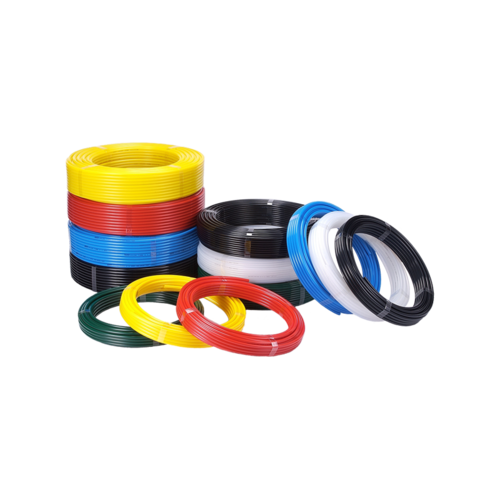
Nylon 12 Tubing (PA12)
ㆍLow moisture absorption
ㆍDimensional stability
ㆍChemical resistance
ㆍImpact resistance at low temperatures
ㆍAbrasion resistance
ㆍMultiple color options
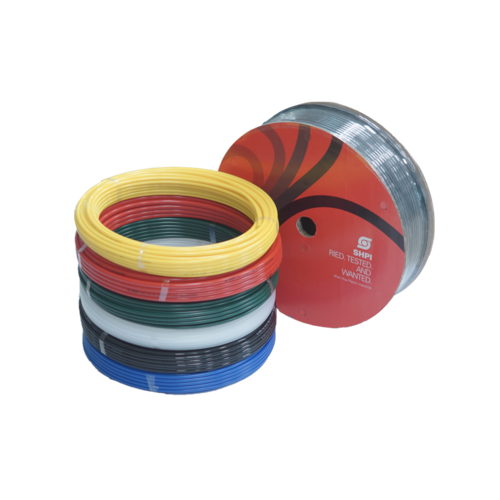
Nylon 6 Tubing (PA6)
・Mechanical strength and stiffness
・Impact resistance
・Chemical resistance
・Abrasion resistance