

Polyurethane Tubing
What Is PU Tubing?
Polyurethane tubing (PU tubing) is a commonly used piping material in industrial automation equipment and pneumatic systems. It is primarily used for compressed air transmission and internal air supply connections within equipment.
Compared with other plastic tubing materials, PU tubing combines flexibility, elasticity, and dynamic bending capability. It is therefore commonly used in space-constrained routing, applications involving repeated bending, or piping locations where relative movement occurs during equipment operation.
Typical Application Scenarios for PU Tubing
- Pneumatic tubing that bends or moves with equipment operation
- Pneumatic piping for automation equipment and pneumatic modules
- Air supply connections for internal pneumatic components within equipment
In practice, tubing selection should be based not only on the material itself, but also on the routing method, environmental conditions, and material characteristics.
→ Pneumatic Tubing Overview (Selection Criteria and Classification)
→ PU vs. Nylon Tubing: Selection and Application Differences
Whether the tubing needs to move with the equipment is one of the key criteria in tubing selection.
When pneumatic lines may be exposed to sparks or high-temperature environments, flame-retardant tubing may be considered as part of the system configuration, such as in welding or metalworking equipment.
In SHPI's product classification, pneumatic tubing designed for these application conditions is referred to as Anti-Spark Tubing.
PU Tubing Construction Types
PU tubing can be classified by construction type as single-layer PU tubing or reinforced PU hose with a three-layer construction.
- Single-layer PU tubing: Primarily used where flexibility and dynamic bending are required.
- Reinforced PU hose: Incorporates a fiber reinforcement layer between the inner and outer PU layers to limit radial expansion under working pressure.
PU Tubing Material Types: What Is the Difference Between ESTER and ETHER?
Depending on the material type, PU tubing differs in hydrolysis resistance, oil resistance, service life, and environmental suitability.
Comparison of ESTER vs. ETHER
| Property | ESTER | ETHER |
|---|---|---|
| Hydrolysis Resistance | ⭐⭐⭐ | ⭐⭐⭐⭐⭐ |
| Oil Resistance | ⭐⭐⭐⭐ | ⭐⭐⭐ |
| Flexibility | ⭐⭐⭐⭐⭐ | ⭐⭐⭐⭐⭐ |
| Service Life | ⭐⭐⭐ | ⭐⭐⭐⭐⭐ |
| Food-Grade Raw Material | ✘ Not Available | ✔ Available |
Further Reading
→ PU Tubing FAQ — 15 Common Technical Questions
→ Flame Retardant Tubing in Welding & Metal Processing
→ One-Touch Fittings Overview | Selection by Tube O.D., Thread Specification, and Connection-End Type
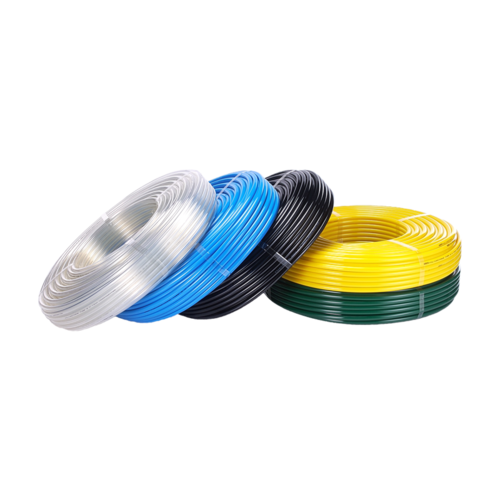
Polyurethane Tubing Ester
.High flexibility
.Good elasticity
.Smooth surface
.Good oil resistance
・Good abrasion resistance
.Multiple colors for circuit identification

Polyurethane Tubing Ether
.High flexibility
.Good elasticity
.Smooth surface
.Hydrolysis resistant
.Low-temperature flexibility
.Resistance to micro-organisms
.Multiple colors for circuit identification