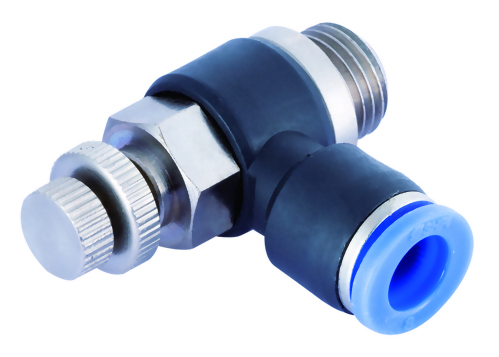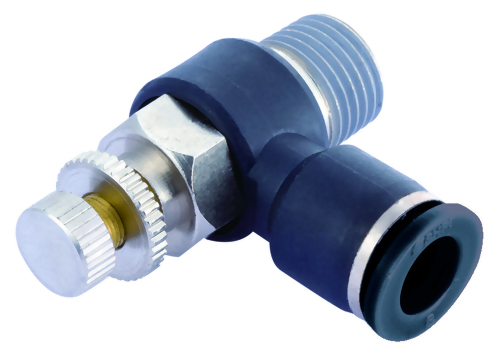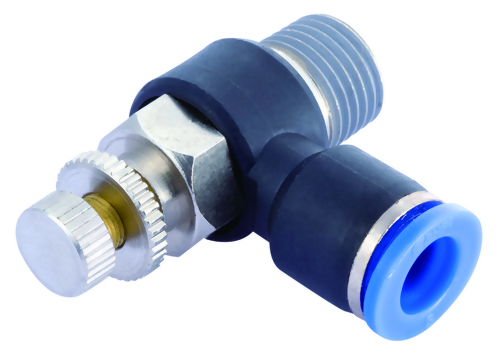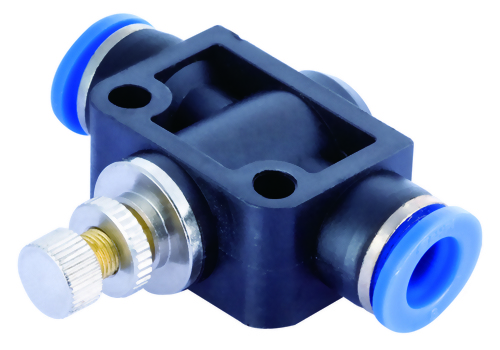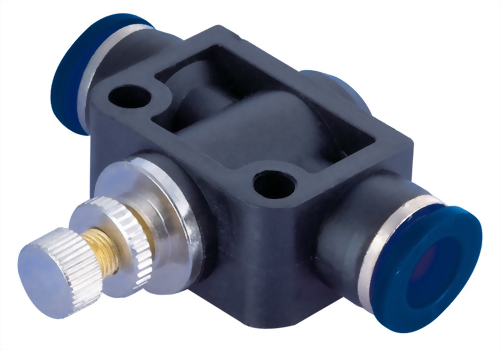

Speed Controllers
Speed Controller One-Touch Fittings Specification Overview
Speed controller one-touch fittings are mainly used to regulate airflow in pneumatic lines, making it easier to control the operating speed of cylinders, clamps, or equipment.
Depending on the piping layout, they can be connected to pneumatic tubing, equipment ports, valves, cylinders, or other pneumatic components.
Turning the knob changes the throttle opening inside the speed controller to adjust flow. A smaller opening reduces flow and slows cylinder or equipment movement, while a larger opening increases flow and speeds up movement.
To understand how metric, inch, G thread, speed controller series, and other one-touch fitting categories are organized, please refer to:
→ One-Touch Fittings Overview|Classification and Selection Criteria
Speed Controller One-Touch Fittings Specification and Type Selection
Speed controller one-touch fittings should be selected based on tube size, thread specification, connection type, adjustment method, and control direction.
The tubing side should match the outside diameter of the pneumatic tubing used. For types with a threaded side, the thread specification should match the equipment port, valve, or pneumatic component port.
| Selection Criteria | Details |
|---|---|
| Tube Size | Select the corresponding metric or inch size based on the tubing outside diameter. |
| Thread |
Select according to the equipment port, valve, or pneumatic component port. Available in M, PT, G, UNF, and NPT thread types. |
| Connection Type | Select according to the connection requirement, such as tube-to-tube or tube-to-thread. |
| Adjustment Method | Flow is adjusted by turning the knob to change the throttle opening. |
| Control Direction | Available for meter-in or meter-out control. Select according to the required airflow control direction. |
Further Reading
→ Metric One-Touch Fittings|Metric Tube Size Specification Overview
→ Inch One-Touch Fittings|Inch Tube Size Specification Overview
→ G Thread One-Touch Fittings|Thread Selection for Equipment Ports