

Air Tubing in Poultry Processing Lines | Food Processing Applications
Behind Every Roasted Chicken: The Invisible Contribution of Food-Grade Pneumatic Tubing
Every year on the fourth Thursday of November, ovens across North America roast a golden turkey—an unmistakable symbol of gratitude and togetherness. But behind that holiday centerpiece is another, unseen “line of operation”: a system built on pneumatics, technology, and hygienic automation that helps each turkey move safely and precisely from farm to table.
You may not realize it, but the United States is one of the world's largest turkey producers. More than 200 million turkeys are processed and packaged each year on tightly controlled, automated production lines. In these environments, tasks such as conveying, positioning, portioning, sealing, labeling, and weighing rely heavily on pneumatic systems. Cylinders, solenoid valves, and sensors work in coordination—and the critical pathway that connects components and delivers the air supply is the air tubing.
Using a turkey processing line as an example, this article explains typical configurations for food-grade air tubing under different operating conditions, along with the practical material-selection logic used in real-world applications.
Typical Configuration Requirements and Pressure Conditions in Food Processing Lines
In food processing facilities, the primary function of pneumatic tubing is to deliver compressed air steadily and consistently to various pneumatic components. In addition to pressure resistance, tubing materials must also withstand exposure to moisture, oil mist, and frequent cleaning procedures, while maintaining stable performance during long-term operation.
Common Tubing Sizes
Across different processing areas and equipment types, commonly used tubing sizes in food processing lines include 1/4", 5/16", and 3/8" (approximately 6.4–9.5 mm).
Typical Operating Pressure Range
Operating pressure is typically within the range of 100–150 psi (approximately 7–10 bar).
Within this range, tubing selection still requires consideration of the actual operating environment and motion characteristics of the system.
Food-Grade Tubing Selection Based on Operating Environment
In food processing lines, operating conditions such as temperature, humidity, cleaning frequency, and motion behavior vary by area. As a result, tubing selection is commonly differentiated based on actual operating environments rather than treated as a single material standard.
Continuous Operation at Ambient Temperature
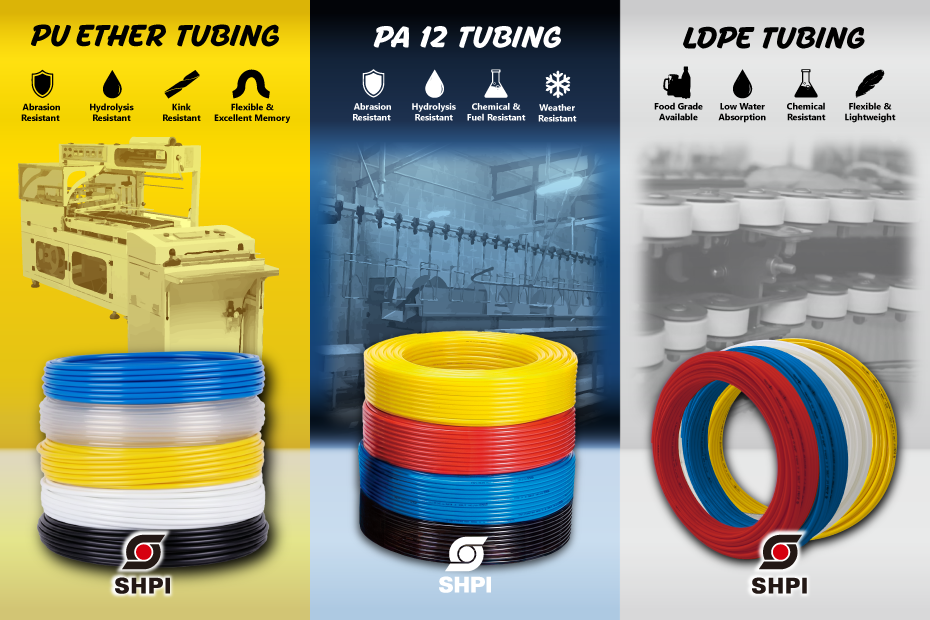
In packaging, labeling, and conveying sections operating under ambient conditions, PU Ether (hydrolysis-resistant polyurethane) tubing is commonly used. It provides good flexibility and maintains stable material behavior in humid operating conditions, making it suitable for high-cycle continuous operation.
High-Pressure Lines and Pneumatic Actuation Zones
In areas involving high-pressure main lines, pneumatic cylinders, or driven mechanical assemblies, PA12 (Nylon 12) tubing is commonly selected to meet stability requirements under long-term load conditions.
Cleaning or Low-Temperature Static Areas
In CIP cleaning systems or low-temperature operating areas, where humidity is high and temperature variation is present, LDPE (Low-Density Polyethylene) tubing is commonly used as a pneumatic tubing option in practical applications.
Typical Tubing Configurations in Turkey Processing Lines
PU Ether Tubing: Packaging, Sealing, and Labeling Equipment
PU Ether tubing is commonly used in packaging sealing machines and labeling equipment, where it maintains stable air pressure under frequent on–off actuation.
PA12 Tubing: Pneumatic Push Mechanisms, Cutting Modules, and Reject Units
PA12 tubing is widely applied in pneumatic push mechanisms, cutting modules, and reject units, maintaining stable pressure and motion accuracy under long-term load conditions.
LDPE Tubing: CIP Cleaning Systems and Low-Temperature Zones
LDPE tubing is commonly configured in CIP cleaning systems and low-temperature operating areas, serving as a pneumatic tubing option corresponding to these operating conditions.
Planning Food-Grade Pneumatic Tubing Solutions
Further Reading: Selection Considerations for Pneumatic Tubing in Food Automation Lines
When planning food processing lines, the selection of pneumatic tubing typically requires integrated consideration of material behavior, operating environment, and cleaning conditions, based on the actual requirements of the production line.
→ Further Reading | PU Tubing Material Structure and Engineering Selection
→ Further Reading | Nylon Tubing (PA Tubing / Nylon Tubing) Material Behavior Differences and Engineering Selection
→ Further Reading | PE Tubing (LDPE) Applications in Humid and Low-Temperature Environments