

AUTOMATION
Role of Pneumatic Tubing in Industrial Automation Equipment
Pneumatic tubing in industrial automation equipment is mainly used to connect the compressed air supply, solenoid valve manifolds, and actuators such as pneumatic cylinders and pneumatic grippers. It carries compressed air to different control points for pushing, gripping, positioning, transfer, and other equipment operations.
Movement, installation space, and routing paths vary across different locations within the equipment. Tubing and connection components should therefore be configured according to the actual operating conditions.
Common Pneumatic Tubing Routing in Industrial Automation Equipment
Pneumatic tubing should be evaluated based on basic conditions such as working pressure, operating temperature, installation space, and environmental conditions.
Fixed Routing
When tubing remains largely stationary after installation, or only undergoes minimal movement, it is classified as fixed routing. Typical locations include machine frames, control cabinets, and pneumatic lines between stationary components.
Repeated bending is not a primary operating condition for this type of routing. PU tubing or Nylon tubing may be evaluated based on the actual operating conditions.
Dynamic Routing
At moving sections of equipment such as robotic arms, sliding systems, and transfer modules, pneumatic tubing may move or bend as the equipment operates.
For this type of routing, the range of tubing movement, bend radius, and repeated bending conditions should be considered. PU tubing may be evaluated based on the actual operating conditions.
Multiple Pneumatic Lines and Grouped Routing
Solenoid valve manifolds in automation equipment can connect separately to multiple pneumatic cylinders, pneumatic grippers, and other actuators. As a result, multiple control air lines may be routed between the valve manifold and the individual actuators.
When multiple tubes are routed along the same or similar paths, the number of pneumatic lines, routing paths, and line identification should be considered. PU tubing can be used for routing. For multiple tubes arranged side by side, please contact SHPI for OEM customization.
Pneumatic Routing and Product Selection
| Routing Scenario | Typical Location | Routing Considerations | Product Selection |
|---|---|---|---|
| Fixed or Low-Movement Routing | Machine frames, control cabinets, and between stationary components | Fixed installation, minimal movement | PU Tubing, Nylon Tubing |
| Dynamic Routing | Robotic arms, sliding systems, transfer modules | Movement distance, bend radius, repeated bending | PU Tubing |
| Multiple Pneumatic Lines and Grouped Routing | Between solenoid valve manifolds and multiple actuators | Number of pneumatic lines, routing paths, line identification |
PU Tubing. For multiple tubes arranged side by side, contact SHPI for OEM customization. |
→ How to Select Pneumatic Tubing: A Guide to Routing Methods and Operating Conditions
→ PU Tubing vs. Nylon Tubing: Selection and Application Differences
→ Pneumatic Tubing, One-Touch Fittings, and Valves: How They Work Together in Pneumatic Systems
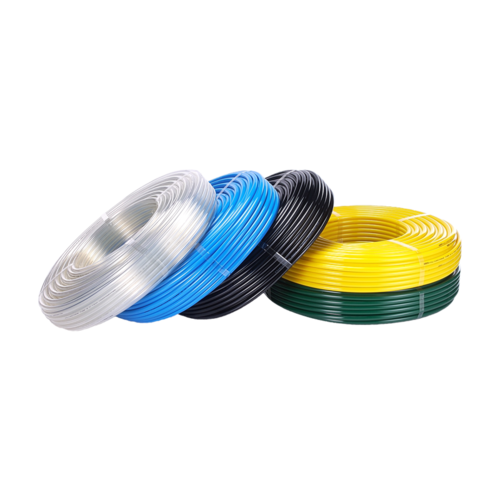
Polyurethane Tubing Ester
.High flexibility
.Good elasticity
.Smooth surface
.Good oil resistance
・Good abrasion resistance
.Multiple colors for circuit identification

Polyurethane Tubing Ether
.High flexibility
.Good elasticity
.Smooth surface
.Hydrolysis resistant
.Low-temperature flexibility
.Resistance to micro-organisms
.Multiple colors for circuit identification
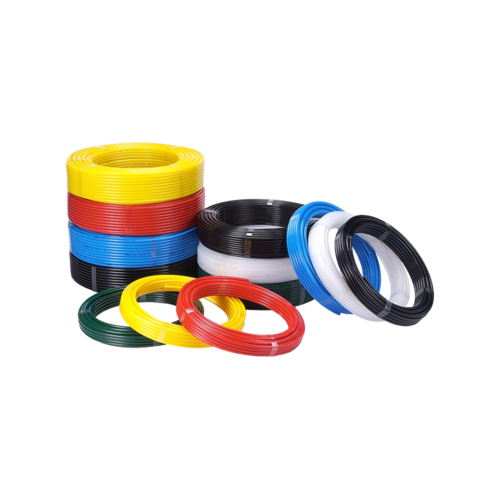
Nylon 12 Tubing (PA12)
ㆍLow moisture absorption
ㆍDimensional stability
ㆍChemical resistance
ㆍImpact resistance at low temperatures
ㆍAbrasion resistance
ㆍMultiple color options
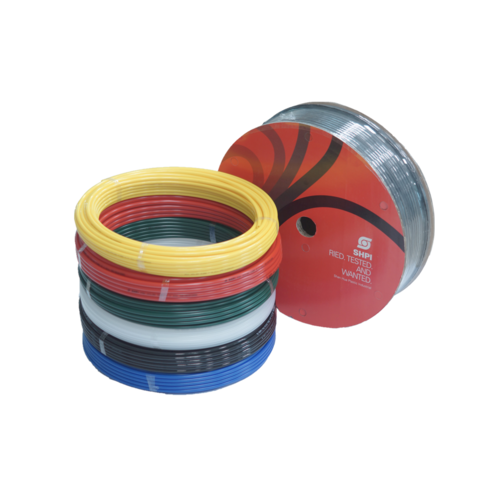
Nylon 6 Tubing (PA6)
・Mechanical strength and stiffness
・Impact resistance
・Chemical resistance
・Abrasion resistance

Polyethylene Tubing LDPE
ㆍModerate flexibility, suitable for fixed or low-dynamic piping configurations
ㆍCommonly used for low-pressure fluid or air transfer applications
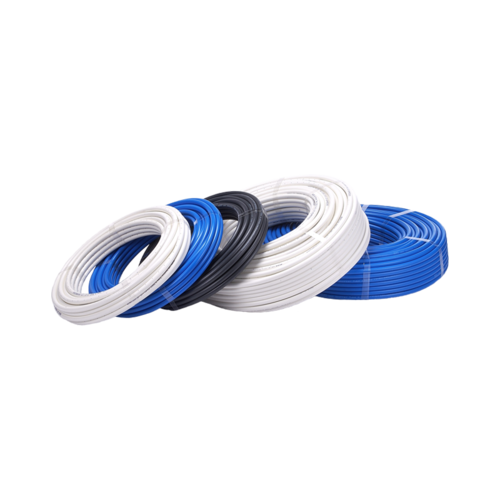
Anti-Spark Tubing
ㆍDual-layer construction: PU inner tubing combined with an outer flame-retardant layer
・Outer layer material meets UL 94 V-0 flammability requirements and has self-extinguishing characteristics
・Structural design intended for tubing surface protection in environments involving welding sparks, spatter, and similar conditions
・PU tubing maintains the flexibility and dynamic bending stability required for pneumatic routing.
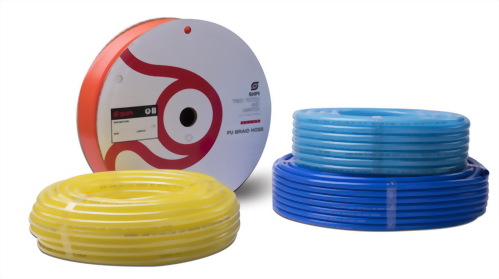
Reinforced Polyurethane Air Hose
ㆍThree-layer polyurethane braided pneumatic hose
ㆍFiber reinforcement layer for higher working-pressure applications
ㆍStable hose shape under pressure variations
ㆍIndustrial compressed-air piping and air-supply applications
