
Catalog
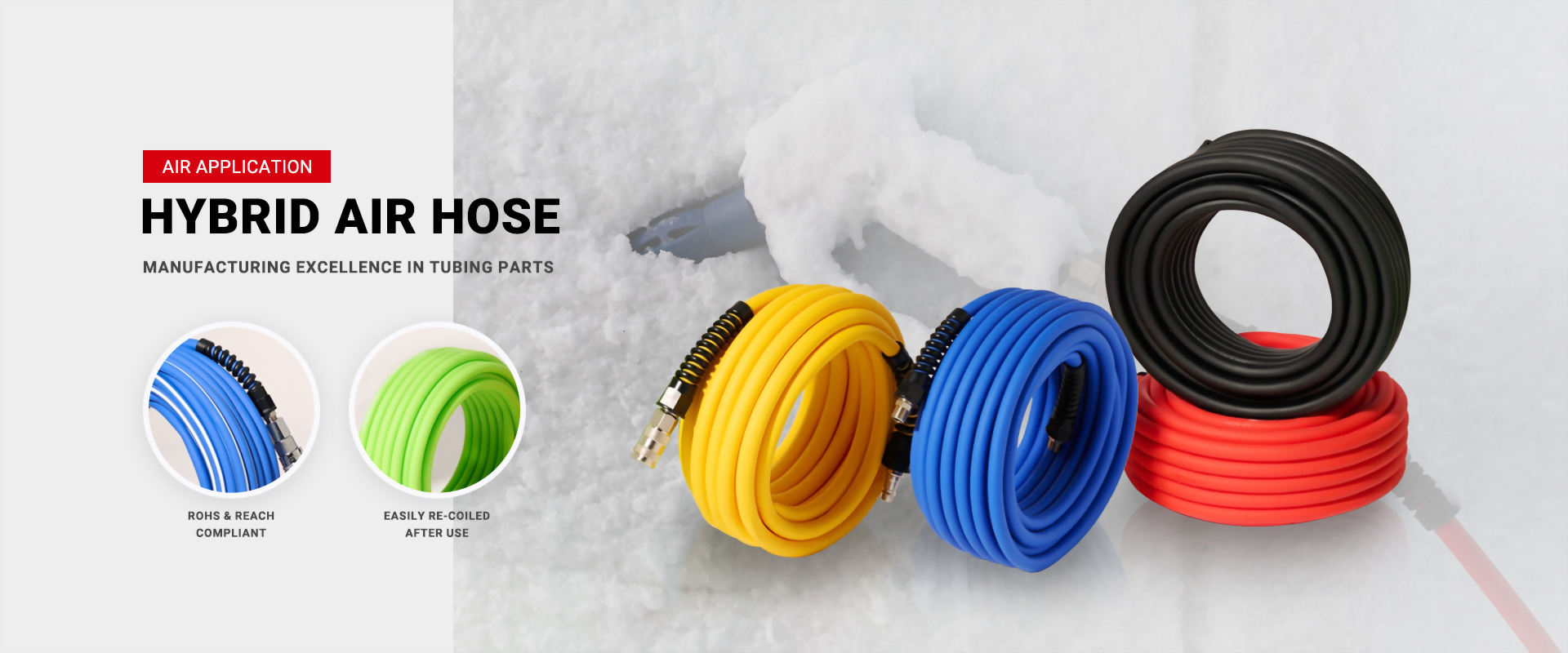
We provide full product details and specifications in catalog format for your convenience.





AUTOMATION

MACHINE TOOLS
CNC machine tools are used to perform precise cutting, drilling, and milling operations on metal and other materials

SEMICONDUCTOR
High-precision wafer and chip manufacturing

AUTOMOTIVE

AIR BRAKE SYSTEM
Air Brake System

HARDWARE

CONSTRUCTION

FOOD
For conveying food-grade liquids - water, cola, beer

HYDRAULIC
Use fluid pressure to transmit force and control industrial machinery

IRRIGATION
Applied in agricultural irrigation, fertigation, and drainage systems
SOLUTION
ABOUT US
MANUFACTURER
Precision-made. Consistently reliable.
SERVICE
Product consulting. Fast support. Tailored solution.
LOGISTICS
Flexible shipping. Global reach.
QUALITY
High-standard testing. Quality assured.
R&D
Ongoing innovation. Reliable solutions.
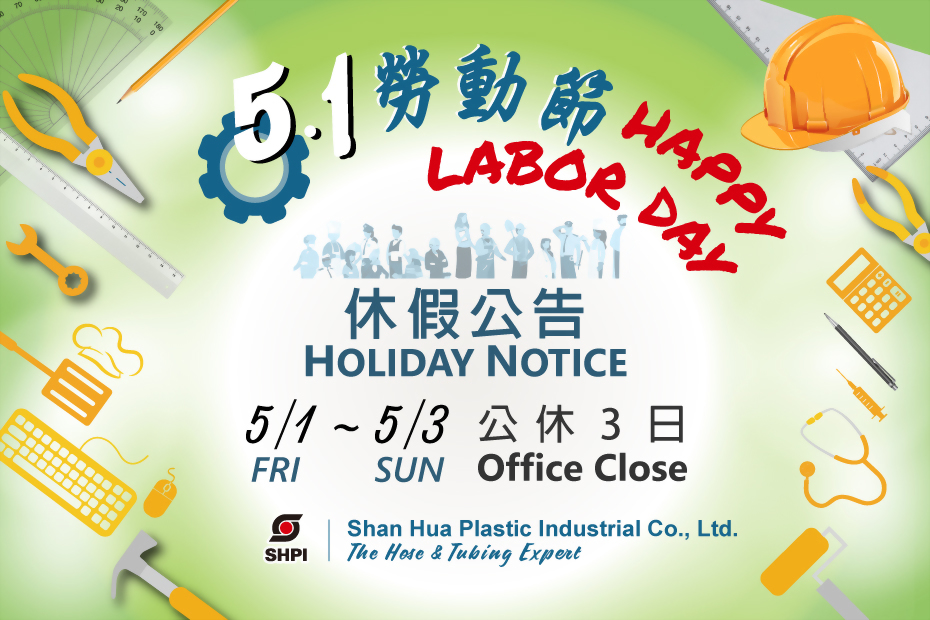
【Notice】International Workers' Day
SHPI will be closed for the Labor
Day on the following dates:
→ Office Closed from May 1–3, 2026
→ Business resumes on May 4, 2026
You're welcome to send inquiries or orders during this period.
We'll respond and follow up once we're back in the office.
CONTACT SHPI NOW >
Read More

How to Select Pneumatic Tubing: A Guide to Routing Methods and Operating Conditions
In pneumatic systems, tubing selection should not be based solely on material names. It should begin with a clear understanding of the application, routing method, and whether regulatory or industry standards apply.
Selection criteria vary depending on the application conditions. For example, automation systems require consideration of whether tubing moves with equipment; fixed routing requires stable positioning; tool-use air lines require consideration of dragging and operating conditions; and commercial vehicle air brake systems require compliance with relevant regulations and standards.
Therefore, pneumatic tubing selection should begin with identifying the intended use, followed by verification against operating conditions and product specifications.
Pneumatic Tubing Selection Process
Tubing selection should follow a step-by-step evaluation based on actual usage conditions, rather than starting from material names.
Confirmation of regulatory and standard requirements
Identification of application
Determination of routing method
Evaluation of operating conditions
Verification of suitability based on product specifications
Selection Based on Routing Method
Routing method is a primary factor in pneumatic tubing selection. Different routing configurations lead to different tubing types.
Dynamic Routing
When tubing is required to move with equipment, undergo repeated bending, or continuously change position, it is classified as dynamic routing.
Typical applications include automation equipment, robotic arms, and sliding systems.
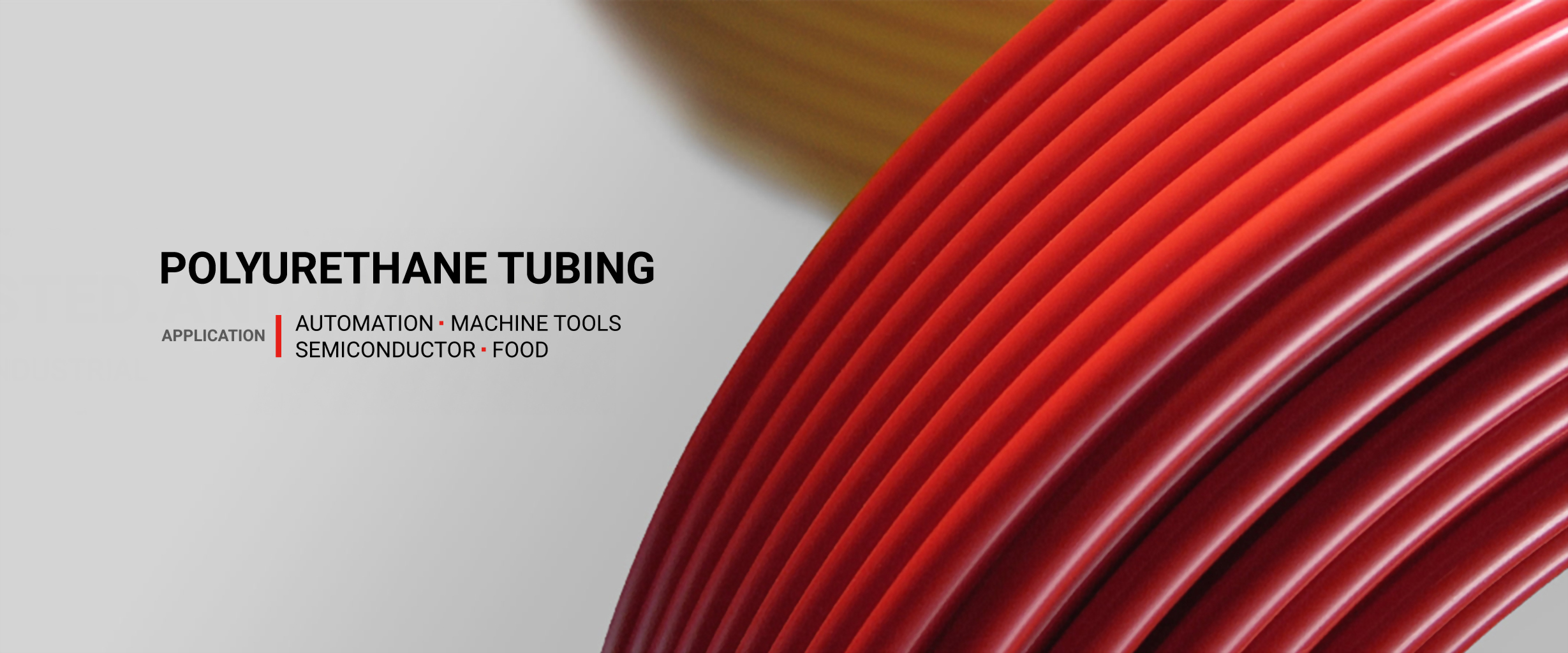
Common selection: PU tubing
Fixed or Semi-Fixed Routing
When tubing remains largely stationary after installation, or only undergoes minimal movement, it is classified as fixed or semi-fixed routing.
Typical applications include main air distribution lines, long-distance transmission, or internal equipment piping.
Common selection: Nylon tubing、 LDPE tubing
Tool and On-Site Air Supply Lines
When tubing is used for air tools, maintenance operations, or on-site air supply, and requires dragging or repositioning, it is considered a tool-use air supply application.
This type of application is neither fixed piping within equipment nor dynamic routing with repeated bending, and requires consideration of ease of handling and operating conditions.
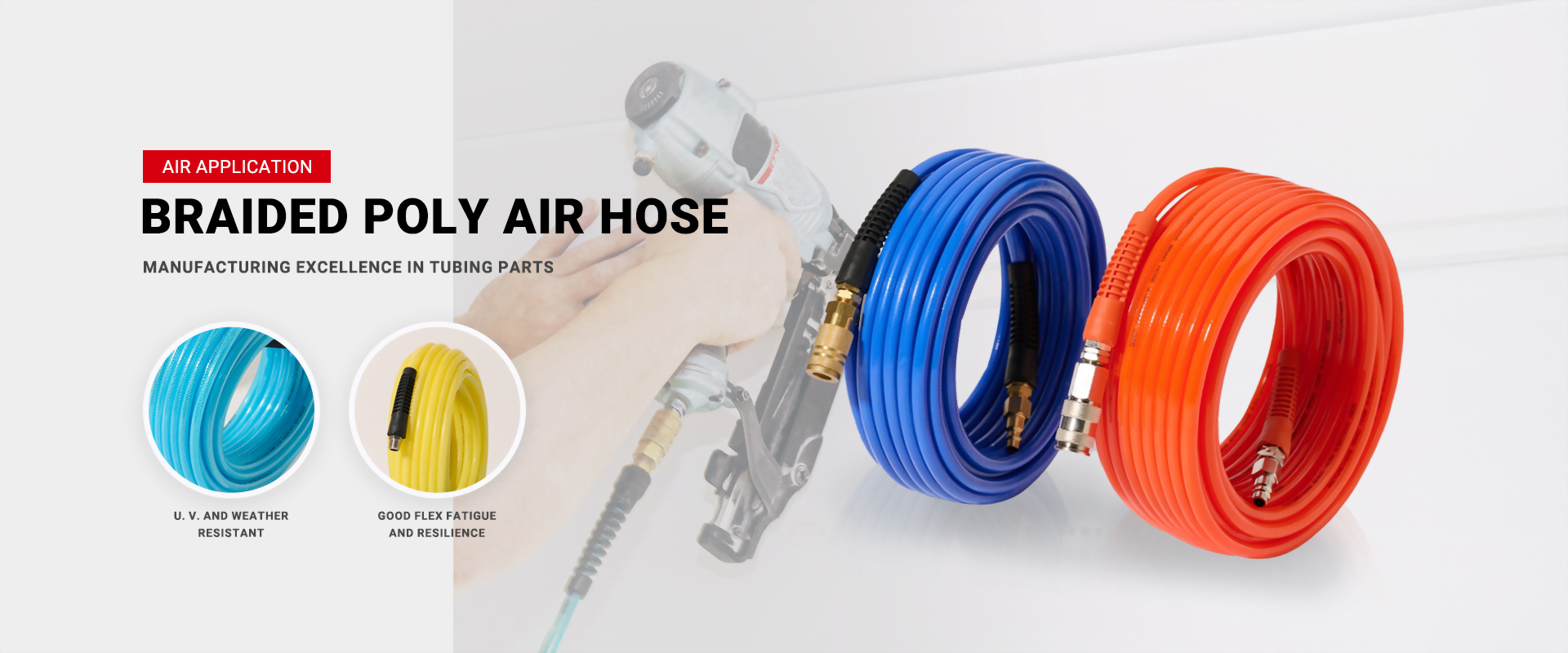
Common selection: Coiled tubing、 Braided air hose(including Hybrid air hose)
Evaluation Based on Operating Conditions
Operating conditions are not the sole starting point for selection, but are used to verify whether the selected tubing type meets actual application requirements.
Key factors include working pressure, temperature, external environment, and proximity to heat or sparks.
Working Pressure Conditions
When applications involve clearly defined higher working pressure, pressure conditions may be used as an initial screening factor to narrow down suitable tubing options.
In practice, tubing type should still be determined based on application purpose and routing method, followed by verification of working pressure ratings for the selected dimensions. Pressure resistance varies depending on tubing diameter, wall thickness, and structural design. Therefore, pressure alone should not be used to determine tubing type.
Temperature Conditions
When tubing is used in low-temperature, high-temperature, or fluctuating temperature environments, actual operating temperature must be considered.
Temperature variations may affect flexibility and bending performance.
Environmental Conditions
When tubing may come into contact with oil mist, liquids, or other media, material compatibility must be evaluated.
Different materials may perform differently depending on the media. Selection should be based on actual exposure conditions.
Spark or Heat Exposure Conditions
When tubing is installed near welding or metal processing equipment, where exposure to sparks or high temperatures is possible, heat and spark impact must be considered.
In such conditions, tubing should be evaluated for flame-retardant characteristics to reduce risk from heat or spark exposure.
Common selection: Anti-Spark Tubing (Flame-retardant tubing)
Typical Tubing Selection by Application Scenario
The following examples illustrate typical tubing configurations under different application conditions.
Automation Equipment
Pneumatic systems in automation equipment often include both dynamic and fixed routing:
Dynamic sections: PU tubing
Fixed sections: Nylon tubing
Commercial Vehicle Air Brake Systems
Tubing used in air brake systems must comply with relevant regulations and standards:
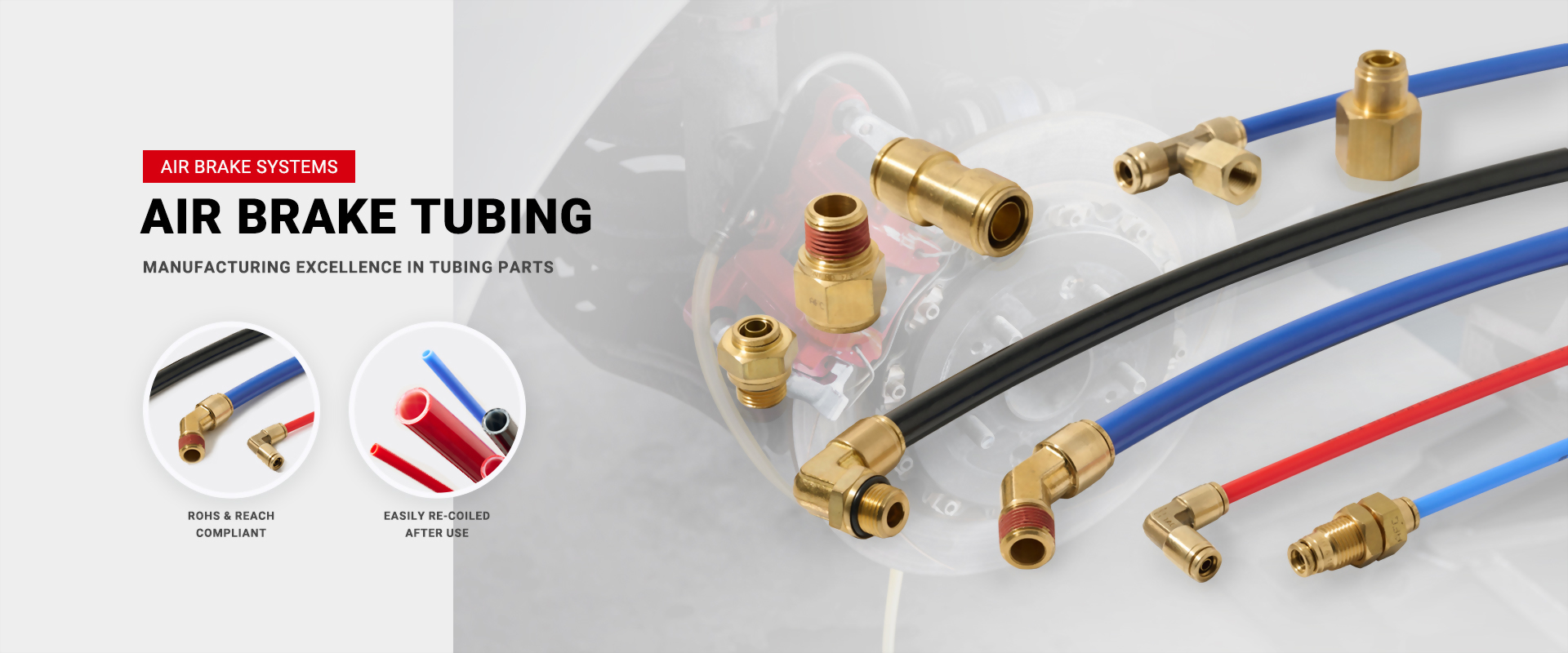
Vehicle internal lines: Air brake tubing
Tractor–trailer connection: Coiled air brake hose
Tool and On-Site Air Supply
Applications involving tools and on-site air supply typically require mobility:
Air supply for tools: Braided air hose / Hybrid Air Hose
Retractable use: Coiled tubing
Key Principles of Pneumatic Tubing Selection
Pneumatic tubing selection should be based on actual application conditions rather than material names or a single factor. In general, the process should begin with confirming regulatory requirements, followed by identifying application purpose and routing method, and finally verifying suitability through operating conditions and product specifications. Material is only one part of the selection process. The key factor is how the tubing is used and whether it matches actual application conditions.
Further Reading
→ Pneumatic Tubing Classification and Selection Mapping (Routing Method × Operating Conditions)
→ PU Tubing vs. Nylon Tubing: Selection and Application Differences
→ Differences Between Air Brake Nylon Tubing and Nylon Tubing
→ UL94 V-0 Flammability Classification
Read More
What Is the Difference Between Air Brake Tubing and Nylon Tubing?
Nylon tubing is widely used in pneumatic and fluid systems, but the requirements for tubing vary depending on the application.
In industrial pneumatic systems, nylon tubing is commonly used for fixed or semi-fixed routing. In commercial vehicle air brake applications, however, nylon tubing used for air brake applications is a dedicated type of tubing and must comply with relevant regulations and standards.
What Is Nylon Tubing?
Nylon tubing refers to polyamide (PA) tubing used in industrial pneumatic and fluid systems.
In practice, it is typically applied in fixed or semi-fixed routing, such as main air distribution lines, long-distance piping, or positions where routing stability needs to be maintained.
→ Nylon Tubing: Materials, Properties, and Applications
What Is Air Brake Tubing?
Air brake tubing is used in commercial vehicle air brake systems. It is typically installed within the vehicle chassis or body, connecting air tanks, brake valves, and other control components to form compressed air transmission lines.
Although it is also a type of nylon tubing, this type of tubing is used for air brake applications and must comply with relevant regulations and standards, such as DIN 74324, SAE J844, or DOT FMVSS 106.
In air brake systems, besides tubing installed within the vehicle, the connection between the tractor and trailer typically uses coiled air brake hose as a dynamic connection.
→ Air Brake Tubing
→ Coiled Air Brake Hose
Why Can't Nylon Tubing Be Used as Air Brake Tubing?
Although both are classified as nylon tubing, air brake applications are application-specific, and tubing selection cannot be determined by material alone.
For air brake applications, the key considerations are not just whether the tubing is nylon, but:
Whether it complies with relevant regulations and standards
Whether it is used for air brake applications
Whether it is installed in the appropriate routing position
Therefore, nylon tubing used in industrial applications cannot be directly assumed to be suitable for air brake use.
→ Air Brake System Tubing Configuration
How to Determine Which Type of Nylon Tubing to Use?
In practice, tubing selection should be based on application rather than material name.
If the tubing is used in industrial pneumatic or fluid systems, nylon tubing is typically a suitable option.
If the tubing is used in commercial vehicle air brake systems, air brake nylon tubing that complies with relevant regulations and standards should be selected.
In other words, material is only one part of the selection process. The actual decision should be based on:
Compliance with regulations and standards
Application type
Routing position
Operating conditions
Further Reading
→ Air Brake System Tubing Configuration
→ Air Brake Tubing
→ Coiled Air Brake Hose
Read More
PU Tubing vs. Nylon Tubing: Selection and Application Differences
PU Tubing vs. Nylon Tubing: Selection Fundamentals
The main difference between PU tubing and Nylon tubing lies in whether the tubing needs to move with the equipment:
If movement or repeated bending is required → Use PU tubing
If the tubing remains fixed or stable → Use nylon tubing
In pneumatic systems, tubing selection affects routing configuration and overall operational stability. Among commonly used pneumatic tubing, PU tubing and Nylon tubing (Polyamide, PA) represent two materials with different characteristics.
These two types of tubing are not interchangeable, but should be selected based on how the tubing is used and the operating conditions. The key factor in selection is how the tubing is used, rather than a comparison of material properties alone.
→ What Is PU Tubing? (Material Properties and Application Fundamentals)
Differences in Material Characteristics Between PU and Nylon Tubing
In pneumatic tubing selection, the differences between PU and Nylon tubing are primarily reflected in routing behavior rather than a direct comparison of material properties.
Characteristics and Usage of PU Tubing
PU tubing is characterized by high flexibility and is suitable for routing configurations that involve movement.
Good flexibility, capable of repeated bending
Good abrasion resistance, suitable for applications involving contact with equipment surfaces
Suitable for routing configurations with frequent directional changes
Commonly used in end-of-line or dynamic sections of equipment
When tubing is required to move with equipment operation, PU tubing is generally the preferred selection.
Characteristics and Usage of Nylon Tubing
Nylon tubing has a relatively stable structure and is suitable for fixed or less frequently changing routing configurations.
Good dimensional stability, suitable for fixed routing paths or long-distance installations
Suitable for applications where tubing does not require frequent movement after installation
Commonly used in main trunk lines or fixed sections of equipment
Nylon tubing commonly includes PA6 and PA12. In general, PA12 has lower moisture absorption and maintains more stable dimensions under changing environmental conditions. Actual material selection should still be based on specific operating requirements.
PU vs. Nylon Tubing Comparison
Comparison Item
PU Tubing
Nylon Tubing
Application
Suitable for tubing that moves with equipment
Suitable for fixed or less frequently changing routing
Flexibility
High flexibility, suitable for repeated bending
Lower flexibility, not suitable for frequent bending
Abrasion Resistance
Performs consistently when in contact with surfaces during movement
Suitable for general applications
Dimensional Stability
Lower dimensional stability compared to nylon
More stable under fixed conditions
Typical Applications
End-of-line or moving sections of equipment
Main trunk lines or fixed sections
What Situations Are Suitable for PU Tubing?
When tubing needs to move with equipment or undergo repeated bending during operation, PU tubing is commonly selected.
Typical situations:
Tubing follows moving components (such as robotic arms or sliding mechanisms)
Tubing requires continuous bending during operation
Routing paths are complex
Tubing may come into contact with equipment surfaces
Under these conditions, PU tubing is more suitable for applications involving movement.
→ Learn more about the characteristics and applications of PU tubing
What Situations Are Suitable for Nylon Tubing?
When tubing remains mostly stationary after installation or when stable routing needs to be maintained, nylon tubing is commonly used.
Typical situations:
Tubing is used in main trunk lines or long-distance routing
No frequent movement is required after installation
Routing direction needs to be maintained
The operating environment involves temperature or humidity changes
Under these conditions, nylon tubing is more suitable for applications requiring stable routing.
→ Learn more about the characteristics and applications of Nylon tubing
How PU and Nylon Tubing Are Used Together in the Same System
In actual systems, PU tubing and nylon tubing are often used together rather than selecting only one type.
Common configurations:
Main trunk lines: nylon tubing (fixed)
End-of-line or moving sections: PU tubing (dynamic)
This type of configuration balances system stability and operational flexibility.
How to Decide Between PU and Nylon Tubing
When selecting pneumatic tubing, the following guidelines can be used for quick evaluation:
If the tubing needs to move → use PU tubing
If the tubing remains fixed → use nylon tubing
If the system includes both moving and fixed sections → use both
Tubing selection should primarily be based on how the tubing is used, rather than only comparing material properties.
PU vs. Nylon Tubing FAQ
What is the difference between PU tubing and Nylon tubing?
The main difference between PU tubing and Nylon tubing lies in whether the tubing needs to move. PU tubing is suitable for dynamic applications requiring flexibility and repeated bending, while nylon tubing is more suitable for fixed configurations that require dimensional stability.
Should I choose PU tubing or Nylon tubing for pneumatic systems?
The most direct way to decide is whether the tubing needs to move. If movement or flexible routing is required, PU tubing is typically used; if the tubing is fixed and requires stable configuration, nylon tubing is generally preferred.
Can PU tubing replace Nylon tubing?
Whether PU tubing can replace Nylon tubing depends on the application conditions. PU tubing is used for dynamic routing, while nylon tubing is used for fixed configurations, and the two are not always directly interchangeable.
Can Nylon tubing be used in moving applications?
Nylon tubing can be used in low-frequency or small-range dynamic applications. However, under conditions involving continuous or repeated bending, it is generally not recommended as the primary choice.
Read More
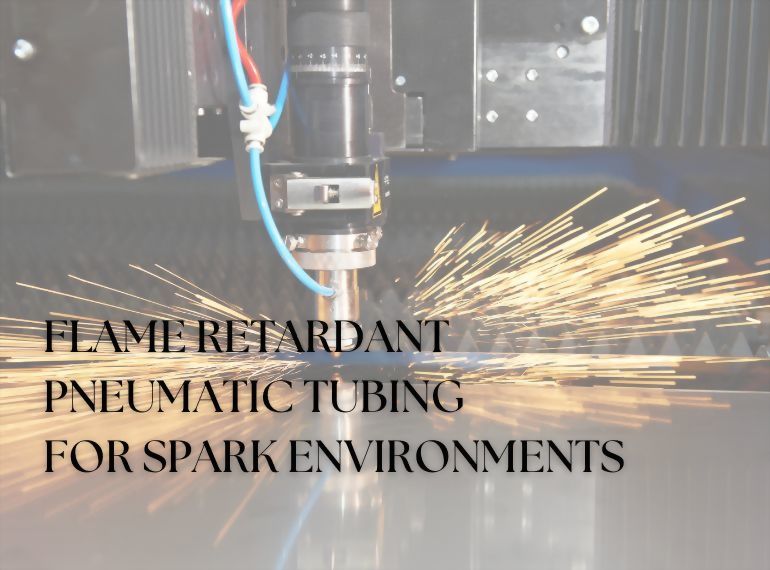
Flame Retardant Tubing in Welding & Metal Processing | Pneumatic Systems Applications
Pneumatic Systems in Welding and Metal Processing Equipment
In welding, laser cutting, and various metal processing equipment, pneumatic systems are commonly used for fixture clamping, cylinder actuation, and automated mechanisms. Compressed air is delivered through pneumatic tubing to actuators, enabling clamping, positioning, and motion control.
These pneumatic lines are typically routed along machine structures or between moving components. In some configurations, tubing may be positioned near welding or metal processing zones.
Operating Environment in Welding and Metal Processing
Welding and metal processing equipment are commonly used in automated production lines, metalworking machines, and certain machine tool applications.
During operation, these systems may involve welding sparks, high-temperature metal spatter, cutting heat, or localized heat sources, such as:
MIG / MAG welding systems
TIG welding systems
Spot welding systems
Laser welding systems
Metal cutting and grinding equipment
In automated production lines, these systems are often integrated with robotic arms, automated fixtures, or conveyor systems, making pneumatic control systems part of the overall equipment configuration.
When pneumatic tubing is routed near welding or processing zones, system design typically considers the potential impact of sparks or elevated temperatures on the tubing.
Role of Flame Retardant Tubing in Welding Applications
When operating environments involve sparks or elevated temperatures, flame retardant tubing may be used. Flame retardant tubing can reduce the likelihood of sustained burning after exposure to a flame source, and their performance is typically classified based on UL94 ratings.
In such applications, UL94 classifications are commonly used as a reference for material selection, particularly in evaluating burning behavior and self-extinguishing characteristics after removal of the ignition source.
Typical application positions include:
Pneumatic control lines around welding equipment
Tubing used in robotic welding systems
Compressed air supply lines near metal processing equipment
Pneumatic systems located near high-temperature zones
In SHPI product classification, pneumatic tubing designed for these conditions is referred to as Anti-Spark Tubing, commonly known as Flame Retardant Tubing in industrial applications. Selection should be based on actual operating conditions and required UL94 classification levels.
Related Products
→ Flame Retardant Tubing
Further Reading
→ UL94 V-0 Classification
Read More
UL94 V-0 Classification | UL94 Flammability Test Standard
What Is UL94 Flammability Testing?
UL94 is a flammability testing standard for plastic materials developed by Underwriters Laboratories (UL), used to evaluate the combustion behavior of materials when exposed to a flame.
It also functions as a standardized testing and classification system, where materials are categorized based on their combustion behavior using consistent and defined test methods.
This standard is widely applied to plastic materials used in electronic equipment, electrical components, and various industrial devices. It can also be used to evaluate the combustion behavior of tubing used in pneumatic systems.
In pneumatic systems, this classification is commonly referenced when selecting flame retardant tubing for environments with potential spark or heat exposure.
In practical applications, such materials are typically used in pneumatic system configurations for welding or metal processing equipment.
What Does UL94 V-0 Mean?
The UL94 vertical burning test classifies materials based on their combustion behavior, primarily evaluating flame extinguishing time and dripping behavior.
V-0 (also written as UL94 V0) is one of the material classifications defined by this test.
During testing, the specimen is positioned vertically and exposed to a flame for a specified period. After the flame is removed, the duration and characteristics of burning are recorded to determine the classification.
If a material meets the UL94 V-0 criteria, it indicates that the material has a relatively fast self-extinguishing capability after the flame source is removed, reducing the likelihood of sustained burning and flaming drips.
Among the classifications, V-0 generally represents a higher level of flame retardant performance.
UL94 V-0 Test Criteria
A material must meet the following conditions to be classified as UL94 V-0:
The flame must extinguish within 10 seconds after removal of the ignition source
The afterflame time for each application must meet specified limits
No flaming drips are allowed to ignite cotton placed below the specimen
When these conditions are satisfied, the material can be classified as UL94 V-0.
UL94 V-0, V-1, and V-2 Classification Differences
The UL94 vertical burning test classifies materials into V-0, V-1, and V-2 categories based on combustion behavior. The main differences lie in flame extinguishing time and dripping behavior.
Classification
Flame Extinguishing Time
Dripping Behavior
V-0
≤10 seconds
No flaming drips that ignite cotton
V-1
≤30 seconds
No flaming drips that ignite cotton
V-2
≤30 seconds
Flaming drips are allowed
Related Products
→ Flame Retardant Tubing
In SHPI product classification, pneumatic tubing designed for these application conditions is referred to as Anti-Spark Tubing, commonly known as Flame Retardant Tubing in industrial applications. Selection should be based on actual operating environments and required UL94 classification levels.
Further Reading
→ Flame Retardant Tubing in Welding & Metal Processing
Further reading provides additional context on how flame retardant tubing is applied as part of pneumatic system configurations in welding and metal processing environments.
Read More
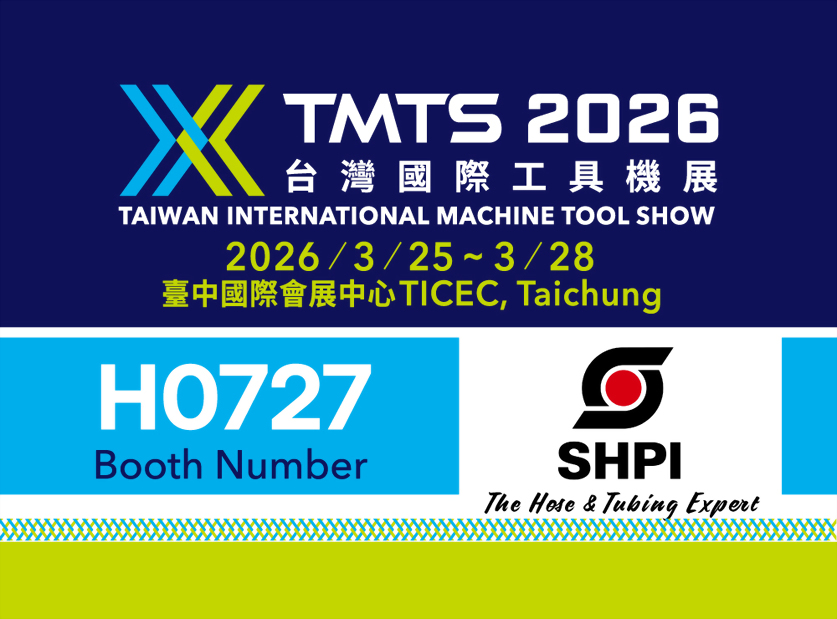
2026 Taiwan International Machine Tool Show
SHPI will participate in TMTS 2026 – Taiwan International Machine Tool Show, presenting pneumatic tubing and high-pressure fluid transmission solutions for machine tools and automation systems.
Our solutions support dynamic routing, fixed air supply lines, and hydraulic applications, helping manufacturers improve system stability and long-term reliability.
Exhibition Information
Exhibition|TMTS 2026 – Taiwan International Machine Tool Show
Dates|March 25–28, 2026
Venue|Taichung International Convention & Exhibition Center, 4F (Shuinan, Taichung)
Booth No.|H0727
Featured Products
PU Tubing Series
Designed for dynamic pneumatic routing in machine tools and automation equipment
Nylon Tubing Series (PA Tubing)
Suitable for fixed compressed air trunk lines and stable air transmission systems
R7 / R8 Hydraulic Hoses
Applied in hydraulic control systems and waterjet applications
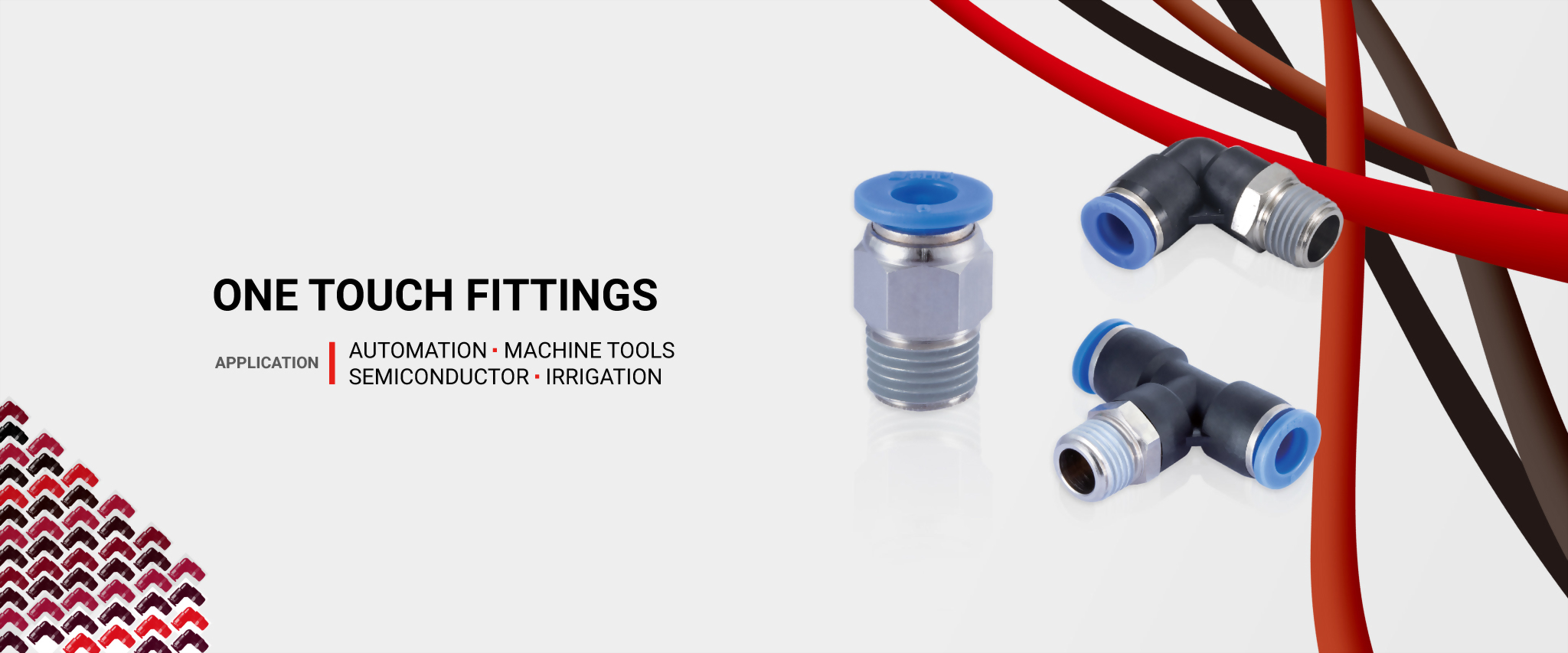
One-Touch Fittings & Quick Couplings
For modular system connections and rapid maintenance operations
✔ OEM / ODM project consultation available onsite
✔ Schedule a meeting|info@shanhua.com.tw
We warmly invite you to visit SHPI at Booth H0727 to discuss engineering applications of fluid systems in machine tools.
CONTACT SHPI NOW >
Read More
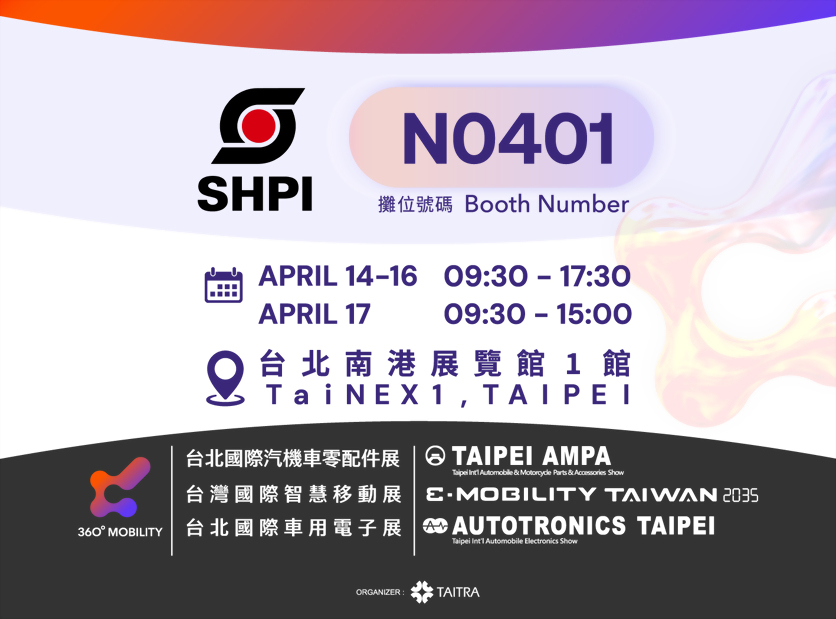
2026 Taipei AMPA
SHPI will participate in TAIPEI AMPA 2026 – Taipei International Auto Parts & Accessories Show, presenting pneumatic and high-pressure tubing solutions for commercial vehicle air brake systems, vehicle maintenance equipment, and heavy-duty transport applications.
For trucks, trailers, buses, and other heavy-duty commercial vehicles, SHPI provides air brake tubing and related fittings compliant with SAE J844 and DOT FMVSS 106 requirements.
We can also provide RoHS and REACH documentation according to different market requirements, supporting partners in building stable and long-term supply systems across various vehicle platforms and international regulations.
Exhibition Information:
Exhibition: TAIPEI AMPA 2026
Date: April 14 – April 17, 2026
Venue: Taipei Nangang Exhibition Center, Hall 1, 4F
Booth: N0401
Featured Products:
Commercial Vehicle Air Brake System Applications
Air Brake Tubing (compliant with SAE J844 / DOT FMVSS 106)
DOT Fittings
Nylon 12 Tubing (PA Tubing)
Suitable for air brake systems in trucks, trailers, and heavy-duty commercial vehicles.
Heavy-Duty Vehicle & Hydraulic System Applications
R7 / R8 Hydraulic Hoses
Suitable for hydraulic systems in construction machinery and heavy transport vehicles.
Vehicle Maintenance & Pneumatic Equipment Applications
PU Tubing Series (including coiled hose and reinforced PU hose)
Quick Couplings and One-Touch Fittings
Flame-Retardant Tubing
Hose Reels
Suitable for pneumatic supply systems used in vehicle maintenance equipment and air tools.
✅ ODM / OEM cooperation consultation available on-site
✅ Meeting appointment|info@shanhua.com.tw
We warmly invite you to visit SHPI Booth (N0401) and explore fluid system applications for commercial vehicles.
Explore Solutions > Contact SHPI >
Read More
Why Stable Taiwan Manufacturing Matters More Than Ever in Today's Supply Chain
Strengthening Supply Chain Resilience Through Stable Taiwan Manufacturing
Prioritizing Long-term Operational Stability Over Short-term Advantages
Amid ongoing global supply chain restructuring, industrial customers are placing increasing emphasis on supply continuity, quality consistency, and long-term partnership reliability. Any supply disruption may directly affect production line stability, delivery schedules, and regulatory exposure, leading industrial sectors in recent years to deepen cooperation and sourcing allocation within Taiwan-based supply chains.
SHPI is a Taiwan-based pneumatic tubing manufacturer with over 40 years of experience in pneumatic hoses, reinforced air hoses, and related fittings. Serving B2B and industrial customers over the long term, SHPI supports the development of supply systems that emphasize operational stability, regulatory alignment, and scalable mass production.
As trade environments continue to evolve, Taiwan manufacturing has shown ongoing improvements in overall operational efficiency and supply risk management. This enables SHPI to rely on a mature manufacturing foundation to support customers’ long-term procurement planning and supply chain deployment.
Cross-Industry Fluid Power Application Experience
SHPI is not only a product manufacturer, but also a technical partner in fluid power applications, with long-term involvement in practical projects and mass-production implementations across a wide range of industries.
High-Cleanliness and Chemical Compatibility Processing Environments
In semiconductor and electronics-related chemical processing, cleaning, and precision manufacturing applications, piping systems must simultaneously account for material cleanliness, chemical compatibility, and long-term material behavior stability under continuous operation.
SHPI provides Nylon 12 tubing (PA12) and PE tubing (Polyethylene) with controlled cleanliness and stable chemical compatibility, suitable for applications with high requirements for process consistency.
High-Speed and Repetitive-Motion Automation Equipment
In high-speed automation systems, repetitive-motion equipment, and robotic applications involving continuous bending, tubing is subject to sustained dynamic loads and long-term material fatigue.
SHPI supplies PU tubing (Polyurethane) with stable fatigue performance, with material configurations differentiated between ester-based and ether-based polyurethane according to actual operating conditions, allowing alignment with diverse environmental requirements.
High-Abrasion and High-Usage Work Environments
In construction projects, automotive repair, and maintenance operations characterized by high usage frequency, SHPI's reinforced PU air hoses, cold-resistant hybrid air hoses, and related pneumatic accessories have accumulated extensive field application experience. These products are applied in work environments where durability and operational stability are required.
Transportation Systems with High Regulatory Safety Requirements
In commercial vehicle and transportation systems, SHPI supplies D.O.T.-compliant straight air brake tubing, coiled air brake hoses, and dedicated D.O.T. fittings. These components support vehicle and fleet operators in maintaining a stable balance between regulatory compliance and practical operational conditions.
Engineering-Oriented Further Reading
→ Further Reading | Pneumatic Tubing Selection for Non-Stop Production | An Engineering Guide
→ Further Reading | PU Tubing FAQ — 15 Common Technical Questions by Automation Engineers
→ Further Reading | Nylon Tubing FAQ — 15 Common Technical Questions by Automation Engineers
Read More
Nylon Tubing FAQ — 15 Common Technical Questions by Automation Engineers
Q1. What kind of material is nylon tubing (PA tubing) in engineering applications?
Technical Summary
Nylon tubing is an engineering plastic tubing material commonly used for fixed or semi-fixed pneumatic and fluid piping systems.
Typical Selection Considerations
• Fixed or semi-fixed piping sections
Q2. Why are PA6 and PA12 the most commonly compared materials for nylon tubing?
Technical Summary
PA6 and PA12 are the most commonly referenced nylon materials for pneumatic tubing applications, and they serve as the primary reference grades in engineering selection.
Typical Selection Considerations
• PA6 and PA12 used for comparative discussion due to clearly distinguishable material behavior
Q3. How do engineers evaluate the material behavior differences between PA6 and PA12?
Technical Summary
Engineers evaluate PA6 and PA12 under actual operating conditions.
Engineering Rationale
Selection is based on observable material responses to ensure stable and predictable behavior within the intended service environment.
Typical Selection Considerations
• Material response to humidity variation
• Stability during long-term operation
• Influence of temperature variation on material state
• Ability to maintain consistent dimensions under fixed piping conditions
Q4. Why is moisture absorption behavior an important evaluation factor when selecting between PA6 and PA12?
Technical Summary
Moisture absorption becomes critical when it affects whether the material can maintain stable and predictable behavior after exposure to humidity.
Engineering Rationale
Nylon is inherently hygroscopic and absorbs moisture from the environment. Absorption may cause dimensional changes and variations in mechanical properties.
Material selection therefore focuses on whether behavior remains stable and consistent after moisture exposure, particularly in applications involving humidity variation or extended operating periods.
Typical Selection Considerations
• Dimensional change after moisture absorption
• Changes in mechanical properties after moisture exposure
• Behavior stability and predictability under humidity variation
Q5. What is the difference between moisture absorption and hydrolysis, and why must they be distinguished in engineering evaluation?
Technical Summary
Moisture absorption causes changes in material state that vary with environmental humidity, while hydrolysis causes irreversible chemical degradation of the material structure.
These behaviors represent different types of engineering risks and must be evaluated separately.
Engineering Rationale
Moisture absorption occurs when the material takes up environmental moisture, which may lead to dimensional changes and variations in mechanical properties.
Hydrolysis occurs when prolonged moisture exposure alters the polymer molecular structure, resulting in permanent chemical degradation that affects long-term durability.
Typical Selection Considerations
• Dimensional and mechanical changes under varying humidity
• Irreversible structural degradation during long-term moisture exposure
Q6. How are engineering risks evaluated for PA6 and PA12 under humidity variation or long-term use?
Technical Summary
Under humidity variation or extended operation, long-term stability differences between PA6 and PA12 are critical factor in engineering risk evaluation.
Engineering Rationale
When piping systems experience significant humidity changes or continuous long-term operation, evaluation focuses on whether material behavior remains stable and predictable over time.
PA6 is more susceptible to dimensional and mechanical changes under moisture influence.
PA12, with lower moisture absorption, typically maintains more stable behavior under the same conditions.
Typical Selection Considerations
• Behavior consistency under humidity variation
• Dimensional and mechanical stability during extended operation
Q7. When PA6 and PA12 are exposed to oil mist or non-air media, what should be considered in material selection?
Technical Summary
Material selection under oil mist or non-air media is determined by actual contact conditions rather than media name alone.
Engineering Rationale
Selection depends on how the material is exposed to the media, not the designation of the media itself.
Key conditions to evaluate include:
• Short-term or long-term exposure
• Continuous or intermittent contact
• Combined effects with temperature, pressure, or usage changes
Evaluation typically relies on chemical compatibility data to determine material suitability.
Typical Selection Considerations
• Duration and continuity of media contact
• Combined environmental and operating conditions
• Chemical compatibility with the intended media
Q8. How do material selection priorities differ by piping position (main line, branch line, equipment end)?
Technical Summary
Material selection requirements vary by piping position, as each section performs a different function within the system.
Typical Selection Considerations
• Main lines: stability during continuous operation
• Branch lines: routing and layout constraints
• Equipment ends: installation conditions and usage variability
Q9. In automation systems, where is nylon tubing typically installed?
Technical Summary
Nylon tubing is typically installed in fixed or semi-fixed piping sections where operating conditions remain stable over time.
Typical Selection Considerations
• Fixed or semi-fixed piping sections
• Stable operating conditions
Q10. Which piping requirements do not align with the typical role of nylon tubing in automation systems?
Technical Summary
Nylon tubing is not typically used in piping sections involving frequent movement, repeated bending, or highly variable operating conditions.
Typical Selection Considerations
• Frequent movement or repeated bending
• Dynamic operating conditions
Q11. Under what usage conditions should the suitability of nylon tubing be re-evaluated?
Technical Summary
Nylon tubing should be re-evaluated when the usage conditions of a piping section change after installation.
Typical Selection Considerations
• New motion requirements
• Changes in usage frequency
• Operating behavior differing from original assumptions
Q12. Under fixed or semi-fixed piping conditions, how do the selection risks differ between PA6 and PA12?
Technical Summary
Under fixed or semi-fixed piping conditions, selection risk between PA6 and PA12 is primarily driven by differences in long-term material stability under environmental variation.
Engineering Rationale
PA6 is more susceptible to humidity-related dimensional and mechanical variation, leading to reduced long-term material stability under fluctuating conditions.
PA12, due to lower moisture absorption, maintains more consistent material behavior under identical environmental conditions.
The difference between PA6 and PA12 lies not in basic usability, but in long-term material stability under varying environmental conditions.
Typical Selection Considerations
• Long-term exposure to environmental humidity variation
• Dimensional and mechanical stability over time
Q13. Quick selection: PA6 or PA12 for fixed or semi-fixed piping
Technical Summary
For fixed or semi-fixed piping applications, selection between PA6 and PA12 is based on environmental humidity conditions and long-term stability requirements.
Engineering Rationale
Under relatively stable operating conditions with limited environmental humidity variation, PA6 is typically sufficient for basic applications.
For applications subject to greater humidity variation, extended continuous operation, or higher long-term stability requirements, PA12 is typically selected due to its more stable material behavior under these conditions.
Typical Selection Considerations
• Magnitude of environmental humidity variation
• Long-term stability expectations
Q14. How should material selection be handled when usage conditions are unclear?
Technical Summary
When usage conditions are not clearly defined, application requirements should be clarified before proceeding with material selection.
Typical Selection Considerations
• Clarity of operating conditions
• Environmental and installation conditions
Q15. If PU Ester also tolerates oil mist, under what conditions should PU be selected instead of nylon?
Technical Summary
When piping requirements involve dynamic use—such as frequent bending or movement—nylon tubing is no longer the typical selection, and PU is generally preferred.
Engineering Rationale
Nylon tubing is primarily intended for fixed or semi-fixed routing where dimensional stability is the main requirement.
For piping sections subject to frequent movement or dynamic motion, materials must accommodate repeated flexing, making PU more suitable for these conditions.
Typical Selection Considerations
• Frequent bending or repeated movement during operation
• Piping sections subject to dynamic motion
Read More
News
TRIED. TESTED. AND WANTED.
Exhibitions