

Hybrid Air Hose FAQ — Low-Temperature Performance, Working Pressure, and Fitting Selection
Q1. Does a Hybrid Air Hose become stiff at low temperatures?
SHPI Hybrid Air Hose is made from a specially formulated PVC compound that helps maintain good flexibility at low temperatures, making it easier to pull, bend, and store. However, cold resistance does not mean that the hose will remain completely unaffected under all low-temperature conditions. The hose should be used within the operating temperature range specified for the product.
Q2. What does low memory mean for a Hybrid Air Hose?
Low memory means that after the hose has been coiled, it is less likely to retain its original coiled shape when used again.
For applications that require long hose runs, frequent movement, or repeated coiling and uncoiling, low memory makes the hose easier to lay out and store.
Q3. What is the difference between a Hybrid Air Hose and a rubber hose?
| Comparison Item | Hybrid Air Hose | Rubber Hose |
|---|---|---|
| Hose weight | Lighter | Heavier |
| Low-temperature flexibility | Uses a special formulation to maintain good flexibility at low temperatures | Generally provides good flexibility at low temperatures |
Both types offer good flexibility and abrasion resistance. The more noticeable difference is hose weight. Hybrid Air Hose is lighter, making it suitable for work that requires frequent carrying, long-distance pulling, or repeated coiling and storage of the hose.
Q4. Is a Hybrid Air Hose suitable for outdoor use?
Yes.
Hybrid Air Hose can be used for outdoor construction, equipment maintenance, and other mobile compressed-air applications. It is especially suitable for low-temperature environments or applications that require frequent pulling, coiling, and uncoiling of the hose.
Suitability for outdoor use does not mean that the hose is unaffected by prolonged exposure to sunlight, rain, or repeated abrasion against the ground. The hose should still be inspected regularly and replaced when signs of wear or aging are found.
Q5. What does a 300 psi working pressure mean?
300 psi is the maximum working pressure for SHPI Hybrid Air Hose in inch sizes at 73°F (23°C). This pressure must not be exceeded during normal use.
The pressure resistance of Hybrid Air Hose is related to the braided fiber reinforcement layer between the inner and outer PVC layers. The reinforcement layer limits radial expansion under pressure and helps the hose maintain dimensional stability.
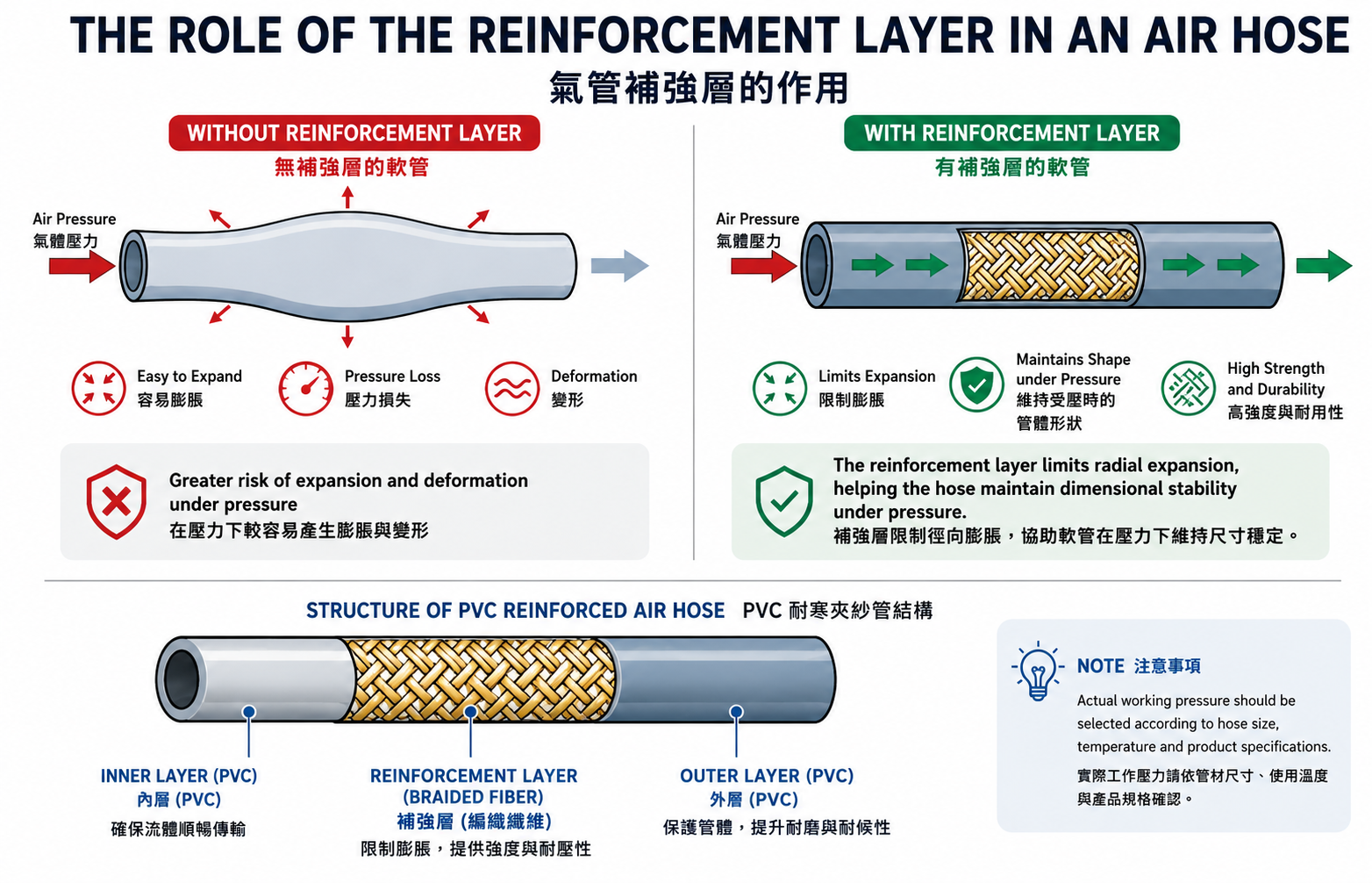
Figure: The reinforcement layer limits radial expansion under pressure and helps the hose maintain dimensional stability.
This product has a safety factor of 3:1, so a working pressure of 300 psi corresponds to a minimum burst pressure of 900 psi. Minimum burst pressure is the pressure at which the hose ruptures during pressure testing. It must not be treated as the normal operating pressure of the equipment.
Before use, refer to the product specification table to confirm the maximum working pressure for the selected hose size at the specified temperature, and follow the listed value.
Q6. What fittings can be used with a Hybrid Air Hose?
Hybrid Air Hose can be assembled with brass fittings, couplers and plugs, or a combination of the two. Each configuration offers different advantages. When selecting a configuration, confirm the fitting size and thread specification, as well as the applicable coupler and plug standard and compatibility between the two.
| Fitting Type | What to Confirm | Advantages |
|---|---|---|
| Brass Fittings | Fitting size: 1/4", 3/8", or 1/2"; PT or NPT thread; male or female thread | Robust construction, good sealing performance, and compatibility with a wide range of equipment |
| Couplers & Plugs | European, American, or Japanese standard, and compatibility between the coupler and plug | Allows quick connection and disconnection, making frequent pneumatic tool changes more convenient |
| Brass Fittings + Couplers & Plugs | Brass fitting size and thread specification, as well as the coupler and plug standard and compatibility | Provides a stable connection while allowing the coupler or plug to be replaced separately |